

Syllabus Structure

Various math and science elements. Blackboard in background with formulas.
Competitive Exam Preparation, Study Techniques, Syllabus Structure

Surface Area and Volume Formulas for CBSE Class 10 Maths with Examples

Surface areas and volumes quantify the size and capacity of three-dimensional objects. They describe how much material covers a solid’s surface and how much space the solid occupies. Using formulas, students calculate surface areas for cubes, cuboids, spheres, cones, and cylinders, and determine volumes for these shapes as well as prisms, pyramids, and hemispheres. These calculations appear in CBSE Class 10 Maths to solve real-world problems such as packaging, construction, and storage. Regular practice of such applications, including through Class 10 online CBSE maths tuition, helps ensure accurate formula use and reliable results in both theoretical and applied questions. In this blog, you will get to know all the important surface area and volume formulas for Class 10 Maths, including their uses and stepwise calculations. Key Surface Areas and Volumes Formulas for CBSE Class 10 Maths Understanding surface areas and volumes is essential for solving real-world 3D problems. Surface area measures the total material needed to cover a solid, while volume calculates the space it occupies. These calculations are important in construction, packaging, manufacturing, and other practical applications. In Class 10 Maths, formulas simplify these computations for cubes, cuboids, cylinders, cones, spheres, and other solids. Total surface area of a cuboid with length l, breadth b, and height h= 2(lb + bh + lh) Lateral surface area of a cuboid= 2(l + b)h Surface area of a cube (edge length l)= 6l² Lateral surface area of a cube (edge length l)= 4l² Volume of a cube= l³ Curved surface area of a cylinder with radius r and height h = 2πrh Total surface area of a cylinder= 2πr(h + r) Volume of a cylinder= πr²h Curved surface area of a cone with radius r and slant height L= πrL Total surface area of a cone= πr(L + r) Volume of a cone= ⅓πr²h Surface area of a sphere= 4πr² Volume of a sphere= 4⁄3πr³ Volume of a frustum of a cone with radii r₁, r₂ and height h= ⅓πh(r₁² + r₂² + r₁r₂) Read more: Complete Guide to Class 10 Maths Formulas Chapter by Chapter Important Formulas for Surface Areas and Volumes (Class 10 Maths) Figure Perimeter / Base Formula Total Surface Area (TSA) Lateral / Curved Surface Area (LSA/CSA) Volume (V) Square 4 × side side² × 6 (if cube considered) – Rectangle 2(l + b) 2(l × b + b × h + l × h) – Parallelogram 2(a + b) b × h – Trapezoid a + b + c + d ½ × (a + b) × h – Triangle a + b + c ½ × base × height – Circle 2πr πr² – Ellipse 2π√((a² + b²)/2) π × a × b – Cuboid 4(l + b + h) 2(lb + bh + hl) 2h(l + b) l × b × h Cube 12 × a 6a² 4a² a³ Cylinder – 2πr(h + r) 2πr × h πr² × h Cone – πr(l + r) πr × l (1/3)πr²h Sphere – 4πr² 4πr² (4/3)πr³ Hemisphere – 3πr² 2πr² (2/3)πr³ Right Pyramid – Base area + ½ × perimeter × slant height ½ × perimeter × slant height (1/3) × Base area × height Right Circular Frustum of Cone – π(R + r)l + π(R² + r²) π(R + r)l (1/3)πh(R² + r² + Rr) Practical Tips for Memorizing Surface Areas & Volumes Formulas Read more: Coordinate Geometry Class 10 Formulas with Solved Examples Applications of Surface Areas and Volumes
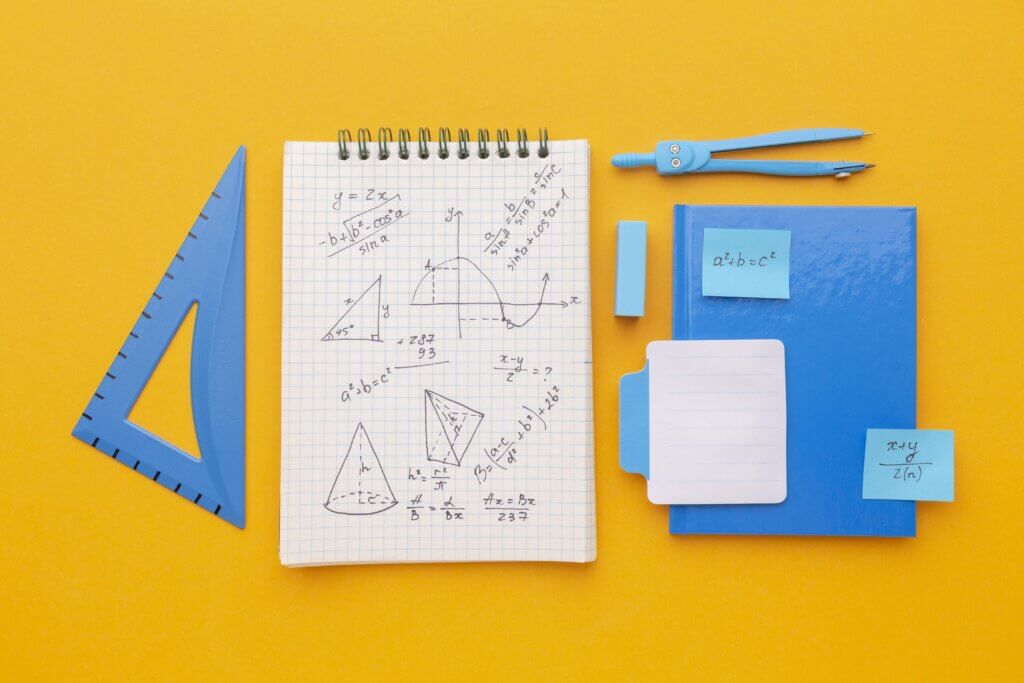

CBSE Class 10 Maths Trigonometry Formulas
Competitive Exam Preparation, Educational Strategies, Study Techniques, Syllabus Structure

CBSE Class 10 Maths Trigonometry Formulas with Examples

Trigonometry studies the relationship between angles and sides of a triangle. In Class 10 Maths, it focuses on right-angled triangles, trigonometric ratios, identities, and angle values. These concepts help students calculate heights, distances, and unknown sides using sine, cosine, and tangent functions. Trigonometry also introduces exact values, standard angles, and identities that simplify complex expressions into solvable forms. CBSE uses trigonometry to test logical thinking, formula application, and accuracy across numerical problems. Students can reinforce these skills through Class 10 online CBSE maths tuition. In this blog, you will learn the important trigonometry formulas for CBSE Class 10 Maths, including trigonometric ratios, identities, and standard angle values, and understand what each formula helps you calculate. Important Trigonometry Formulas for Class 10 Maths Trigonometry formulas help students calculate angles, side lengths, and relationships inside a right-angled triangle. These formulas convert geometric problems into numerical steps using trigonometric ratios and identities. In CBSE Class 10 Maths, trigonometry plays a key role in solving height and distance problems, simplifying expressions, and proving identities. Mastery of these formulas improves speed, accuracy, and scoring consistency in board exams. Trigonometric Ratio Abbreviations The table below shows the standard abbreviations and meanings of trigonometric ratios used in Class 10 Maths. Trigonometric Ratio Abbreviation Meaning Sine Sin Perpendicular ÷ Hypotenuse Cosine Cos Base ÷ Hypotenuse Tangent Tan Perpendicular ÷ Base Cotangent Cot Base ÷ Perpendicular Secant Sec Hypotenuse ÷ Base Cosecant Cosec Hypotenuse ÷ Perpendicular Trigonometric Ratio Formulas Basic Trigonometric Ratios Trigonometric Identities Pythagorean Identities Read more: Complete Guide to Class 10 Maths Formulas Chapter by Chapter Derived Identities Read more: Coordinate Geometry Class 10 Formulas with Solved Examples Reciprocal Identities Read more: Quadratic Equations Formulas CBSE Class 10 Maths Complementary Angle Identities Trigonometric Table (Standard Angle Values) This trigonometric table helps students find the values of trigonometric ratios for standard angles 0°, 30°, 45°, 60°, and 90°. Trigonometric Ratios 0° 30° 45° 60° 90° sin A 0 1/2 1/√2 √3/2 1 cos A 1 √3/2 1/√2 1/2 0 tan A 0 1/√3 1 √3 Not Defined cot A Not Defined √3 1 1/√3 0 sec A Not Defined 2 √2 (2√3)/3 1 cosec A 1 (2√3)/3 √2 2 Not Defined Real Life Applications of Trigonometry Formulas Read more: CBSE Class 10 Maths Formulas for Chapter 3 Pair of Linear Equations in Two Variables Tips to Memorize Trigonometry Formulas for Class 10 Read more: CBSE Class 10 Maths Chapter 10: Important Circle Formulas Trigonometry Formula Example  Question If sin (A + 20°) = cos (2A), where A is an acute angle, find the value of A. Solution Use the complementary angle identity:cos θ = sin (90° − θ) Rewrite the given equation:sin (A + 20°) = sin (90° − 2A) Equate the angles:A + 20° = 90° − 2A Solve the equation:3A = 70°A = 70° ÷ 3A ≈ 23.33°

Coordinate Geometry Class 10 Formulas
Educational Strategies, Study Techniques, Syllabus Structure

Coordinate Geometry Class 10 Formulas with Solved Examples

Coordinate geometry explains geometry using numbers instead of drawings. It places points on a Cartesian plane using ordered pairs of real numbers. Each point depends on an x coordinate and a y coordinate measured from the origin along the X axis and Y axis. This method allows students to measure distance, locate positions, divide line segments, and verify shapes using calculation rather than visual judgment. In CBSE Class 10 Maths, coordinate geometry forms a core part of analytical problem solving and directly supports topics such as linear equations, trigonometry, and mensuration. Students can further strengthen their understanding through online CBSE Class 10 maths tuition. In this blog, you will learn the important coordinate geometry formulas for Class 10 Maths and understand what each formula helps you find. Key CBSE Class 10 Maths Coordinate Geometry Formulas Coordinate geometry converts geometric problems into algebraic calculations on a Cartesian plane. The following formulas help you find distances, locate division points, and calculate areas using coordinate values.  1. Distance Formula (Length Between Two Points) What it finds: Distance between any two points on the plane. Formula: D = √[(x₂ − x₁)² + (y₂ − y₁)²] How to use it: Substitute coordinates (x₁, y₁) and (x₂, y₂) into the formula and evaluate the square root.Used for perimeter, length, and position problems. Read more: Complete Guide to Class 10 Maths Formulas Chapter by Chapter 2. Section Formula (Divide Line Segment in Ratio) The section formula gives coordinates where a point divides a line segment in a given ratio. Internal Division (m : n): (x, y) = ((m·x₂ + n·x₁) / (m + n), (m·y₂ + n·y₁) / (m + n)) External Division (m : n): (x, y) = ((m·x₂ − n·x₁) / (m − n), (m·y₂ − n·y₁) / (m − n)) Use: Find a point that splits a line segment either inside (between) the endpoints or outside them. Read more: Quadratic Equations Formulas CBSE Class 10 Maths 3. Midpoint Formula (Equal Division Point) What it finds:Point exactly halfway between two coordinates. Formula:Midpoint of (x₁, y₁) and (x₂, y₂) = ( (x₁ + x₂)/2, (y₁ + y₂)/2 ) Use: Quickly locate the center of a segment without using ratios. 4. Area of a Triangle Using Coordinates What it finds: The area enclosed by a triangle formed by three points. Determinant-based Formula: Area = ½ | x₁(y₂ − y₃) + x₂(y₃ − y₁) + x₃(y₁ − y₂) | Use: Helps check whether three points form a triangle or are collinear (zero area). Read more: CBSE Class 10 Maths Formulas for Chapter 3 Pair of Linear Equations in Two Variables Applications of Coordinate Geometry Formulas Coordinate geometry formulas solve real location and distance problems using numerical data. Tips to Memorize and Use These Formulas Follow these study tactics to learn formulas faster: Read more: CBSE Class 10 Maths Trigonometry Formulas with Examples Example: Finding Distance Between Two Points Question:Find the distance between the points A(2, −3) and B(6, 3). Step 1: Identify the coordinates A(x₁, y₁) = (2, −3)B(x₂, y₂) = (6, 3) Step 2: Apply the distance formula Distance = √[(x₂ − x₁)² + (y₂ − y₁)²] Step 3: Substitute the values Distance = √[(6 − 2)² + (3 − (−3))²]Distance = √[(4)² + (6)²]Distance = √(16 + 36) Step 4: Simplify Distance = √52Distance = 2√13 units Answer:The distance between points A and B equals 2√13 units.

Lecturer talking to college students in classroom
Competitive Exam Preparation, Parenting Tips, Syllabus Structure

ICSE vs CBSE Differences | Which Board Is Better for Students

Every parent faces a crucial decision when choosing a school board for their child. The debate often comes down to CBSE (Central Board of Secondary Education) and ICSE (Indian Certificate of Secondary Education). CBSE emphasizes science, mathematics, and analytical skills, providing strong preparation for national competitive exams such as JEE and NEET.  ICSE focuses on English, literature, and holistic development, building skills for international education and fostering critical thinking and creativity. In this blog, you will get to know the differences between CBSE and ICSE, including syllabus structure, assessment methods, and skill development approaches, to help you make an informed decision for your child’s education. What is the CBSE Board? CBSE stands for Central Board of Secondary Education. Established in 1962, CBSE operates under the Ministry of Education, Government of India. It serves as the primary educational board for both public and private schools across India, with over 20,000 affiliated schools nationwide. The CBSE curriculum is developed by the National Council of Educational Research and Training (NCERT) to provide uniform, structured, and student-friendly education. It emphasizes science, mathematics, and analytical thinking, making it ideal for students preparing for national competitive exams like JEE (Joint Entrance Examination) and NEET (National Eligibility cum Entrance Test).  CBSE covers a wide range of subjects, including science, mathematics, social sciences, arts, and humanities, while maintaining a focus on concept clarity and foundational learning. Key Advantages of CBSE: Disadvantages of CBSE: What is the ICSE Board? ICSE stands for Indian Certificate of Secondary Education. It is conducted by the Council for the Indian School Certificate Examinations (CISCE), a private board established in 1958 to deliver high-quality education to Indian students. ICSE Class 10 students appear for ICSE Board Exams annually between February and March, while Classes 11 and 12 follow the ISC (Indian School Certificate) curriculum, also examined in February–March each year. The ICSE curriculum is known for its comprehensive and balanced approach, giving equal weight to English, arts, and science subjects. It emphasizes application-based learning, project work, and internal assessments, ensuring students gain practical knowledge alongside theoretical understanding.  ICSE prepares students effectively for national and international higher education opportunities, and builds skills in critical thinking, creativity, and research. Key Advantages of ICSE: Disadvantages of ICSE: CBSE vs ICSE: Key Differences CBSE provides a streamlined, India-centric curriculum ideal for students targeting competitive exams such as JEE and NEET. ICSE, on the other hand, offers a broader, in-depth syllabus that emphasizes English proficiency, critical thinking, and a holistic education with international recognition. Choosing between the two depends on a student’s learning style, academic goals, and whether they seek a nationally aligned or globally oriented education. Curriculum & Syllabus Examination & Assessment Teaching Style Medium of Instruction Difficulty Level Global Recognition & Opportunities Fees & Affiliation Scholarships CBSE vs ICSE: Grading System CBSE Grading System Grade Grade Point Marks Range A1 10 91–100 A2 9 81–90 B1 8 71–80 B2 7 61–70 C1 6 51–60 C2 5 41–50 D 4 33–40 E1 & E2 0 21–32 ICSE Grading System Grade Standard 1 & 2 Very Good 3, 4 & 5 Pass with Credit 6 & 7 Pass 8 & 9 Fail Final Verdict: Which Board is Better? There is no absolute “better” board—it depends on the student’s goals and learning style. CBSE is ideal for students aiming for competitive exams in India due to its focused syllabus and structured approach. ICSE suits those seeking a broader, in-depth education, strong English skills, and global academic opportunities. Parents should choose based on their child’s strengths, future aspirations, and preference for either a nationally aligned or internationally oriented education.

Scroll to Top